
Overtaking: when to go, when to abort, and how to come back
The one everyday manoeuvre that is legal here, prohibited a hundred metres later, and left to your judgment in between. Ranged from the clear end to the forbidden one, with the arithmetic of the middle and a verdict that is not hidden in it.
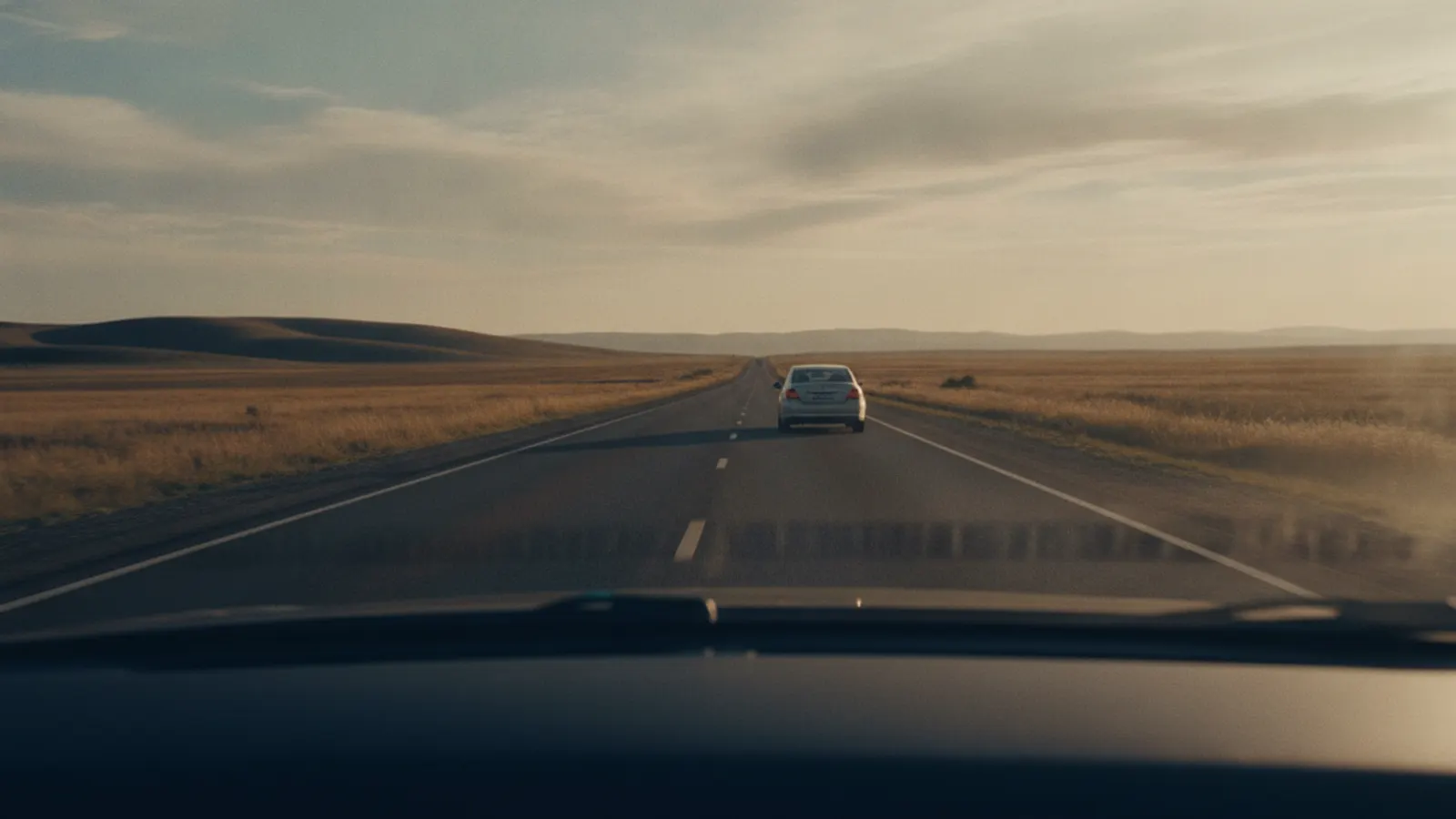
Overtaking is the only manoeuvre an ordinary driver performs that can be lawful here, forbidden a hundred metres on, and left entirely to judgment in between — and what decides which of the three you are in is usually a line painted on the road. It is a practice with degrees, so this article ranges it: the overtake that is clearly legal and clearly safe at one end, the one a marking or a code prohibits outright at the other, and between them the marginal overtake on a two-way road, where the sight distance is adequate only if every assumption holds.
A piece built this way can let the contested middle absorb its verdict. This one does not: our line has a section of its own and the heading says so.
The clear end: where nothing is coming the other way
On a motorway or a dual carriageway the directions of travel are separated, and the arithmetic that makes overtaking dangerous is absent. What remains is lane discipline, and two codes written for opposite sides of the road give the same instruction in mirror image. The Highway Code’s motorway rule is to keep in the left lane unless overtaking, and to return to it when it is safe. Spain’s Reglamento General de Circulación says the same for right-hand traffic: outside built-up areas, on a carriageway with more than one lane in the direction of travel, a driver normally uses the one furthest to the right, and may use the others when traffic or the road advises it, provided this does not obstruct a following vehicle. Both make the overtaking lane a place you pass through rather than sit in, and neither makes the pass a matter of judgment about oncoming traffic, because there is none.
The other clear end: where the decision was taken before you arrived
At the far end of the range the road has already decided. A continuous longitudinal line, in the Spanish catalogue of road markings, means that no driver may cross it, drive on it, or travel to the left of it where it separates the two directions. The Highway Code’s version is that double white lines with the solid line nearer to you MUST NOT be crossed or straddled, with narrow exceptions — premises or a side road, a stationary vehicle, a road user travelling at 10 mph or less — and then only if the road is clear.
Alongside the lines sit the places where the prohibition follows the geometry rather than the paint: a corner or bend, a hump bridge, the brow of a hill, a junction on either side of the road, a level crossing, the approach to a crossing. The Spanish prohibition is drafted more tightly, and worth reading slowly: overtaking is forbidden on bends and crests of reduced visibility and, in general, in any place or circumstance where the available visibility is not sufficient to carry out the manoeuvre or to abandon it once begun.
That clause is the hinge of the subject, and the reason the middle is narrower than drivers treat it.
The contested middle: the two-way overtake that only just works
Here is the arithmetic nobody does at the wheel. Two published numbers describe the same stretch of two-lane road, and they differ by a factor of about two. The design value, reproduced by state highway manuals from the AASHTO Green Book, is the sight distance a road should offer so the pass can be completed: about 2,135 feet at a 60 mph design speed, roughly 650 metres, and about 1,090 feet at 30 mph. The value that decides where the no-passing markings are actually painted is shorter, because it is built on the distance needed to abort: the federal markings manual requires them wherever passing sight distance falls below 1,000 feet at 60 mph, or 500 feet at 30 mph.
The design manual states the distinction itself and warns designers not to confuse the two. It matters to a driver because it says what a broken line is promising. Where the centre line is broken, the authority has satisfied itself that you can see far enough to change your mind. It has not told you that you can see far enough to finish.
The rest of the model is a chain of assumptions, each reasonable and each capable of failing on the day. The overtaken vehicle is assumed to hold a uniform speed, and the passing vehicle to average ten miles an hour more. The clearance left to the oncoming vehicle at the end of the manoeuvre is between 100 and 250 feet. And that oncoming vehicle — not there when you decide, there when you commit — is assumed to travel at your own speed, approaching for two thirds of the time you spend in its lane. At the 60 mph design case those speeds are 57 mph each, so the distance between you closes at 114 miles an hour, near enough 183 kilometres an hour. That is the number the eye is asked to judge, from the driver’s seat, in traffic, once.
It is worth knowing what arrives at the front of the car when this fails. Of the 22,115 fatally injured passenger vehicle occupants aged 13 and older recorded by the Insurance Institute for Highway Safety for 2024, 13,228 were in frontal impacts — more than side, rear and rollover together. That category is broader than the head-on collision, since it includes striking a fixed object, so it is not a count of overtaking crashes; what it establishes is where the fatal energy arrives.
The crash simulator, opened on a lane-change sideswipe, is the place to see this rather than read it.
Our line, and why
Do not begin a two-way overtake you could not abandon. That is the test the Spanish prohibition writes into law, and it is stricter than the one drivers use, which is whether the pass looks completable.
The two tests fail differently. Judge completion wrongly and the only remedy left is to accelerate into a gap closing at the sum of two speeds, spending a margin that was never yours. Judge abandonment wrongly and you lift off, drop back, and lose a minute. That asymmetry is the argument, and it is why we state a verdict rather than balance two reasonable positions: one error is recoverable, the other is not.
Two corollaries follow. Do not pass more than one vehicle at a time unless you are certain you could still move right if something appeared, which the Spanish code requires in terms; and do not follow another car through its overtake, because there may be room for one.
The abort
The instruction for the moment it goes wrong is a statute, not folklore. Spain’s code provides that a driver who, after beginning the manoeuvre, notices circumstances that could make finishing it difficult without creating risk shall quickly reduce speed, return to their own lane, and warn following drivers with the required signals. Slowing, not accelerating, is prescribed.
It only works if the gap you came out of is still there, which is why the Spanish traffic authority’s own guidance tells drivers never to close up the safety gap before an overtake: closing up costs both the view ahead and the room to accelerate. The Highway Code approaches the same point from the front, requiring a suitable gap in front of the road user you plan to overtake before you start.
The return
Coming back has its own failure, which is cutting in. The Highway Code’s instruction is to move quickly past, allow plenty of room, and move back as soon as you can without cutting in. The Spanish requirement is to rejoin your lane as soon as possible and gradually, without obliging others to change their line or their speed, and to signal it. Where double white lines carry direction arrows, the arrows are telling you to get back onto your own side. The mirror comes first, because what you need to see is the vehicle you have just passed, whole, before you begin moving.
Being overtaken, which is also a manoeuvre
Both codes place a duty on the driver who is not overtaking, and it is the one most often forgotten. The Highway Code says to maintain a steady course and speed, slowing if necessary to let the vehicle pass, never to obstruct a driver who wishes to pass, and that speeding up or driving unpredictably while someone is overtaking you is dangerous.
Spain’s code makes it enforceable. The driver about to be overtaken must keep to the right-hand edge, is prohibited from increasing speed or making manoeuvres that prevent or hinder the pass, and must slow if danger develops once the manoeuvre has begun. A further duty has no equivalent in the British text: where the overtaking driver gives unmistakable signs of giving up by slowing, the driver ahead must help them back into lane.
Passing on the side nearer the edge of the carriageway
The rule usually described as a ban on undertaking is narrower than its reputation. On a British motorway you are told not to overtake on the left or move to a lane on your left to overtake — and then told that in congested conditions, where adjacent lanes move at similar speeds, traffic in left-hand lanes may be faster, and that you may keep up with your own lane even if this means passing traffic to your right. Weaving between lanes to get past remains out. Spain reaches the same place by definition: where traffic is so dense that vehicles occupy the full width and each moves at the speed of the one ahead, one lane moving faster than another is not an overtake at all. Read both against your own side of the road: the restriction is on moving to the lane nearer the edge in order to get past, not on that lane being quicker than yours.
What we cannot tell you
We cannot give you a distance in metres for the road you are on. The published figures are design values and marking criteria, measured from a fixed eye height to a fixed object height on a drawing, and none was measured through your windscreen at dusk behind a van. Nor can we tell you how a particular code treats the marginal case: whether an overtake is judged by the marking, by the visibility available, or by both differs by market and is stated in each market’s own traffic code, and the two codes read here already differ on how tightly they draft it.
What survives translation to every market is the test above. If you could not change your mind, you are not overtaking. You are committing.
Frequently asked questions
How far ahead do I actually need to see before overtaking on a two-way road?
Further than most drivers assume, and there are two published answers rather than one. The design value reproduced by state highway manuals from the AASHTO Green Book is the distance needed to complete the pass: about 2,135 feet — roughly 650 metres — at a 60 mph design speed, and about 1,090 feet at 30 mph. The value used to decide where the no-passing markings go is a different and shorter one, because it is built on the distance needed to abort: the Manual on Uniform Traffic Control Devices sets 1,000 feet at 60 mph and 500 feet at 30 mph. Neither is a measurement of your road on the day, and neither is a legal test of your overtake.
I have pulled out and it is going wrong. Do I accelerate through or drop back?
Drop back, and the instruction is in a statute rather than in folklore. Spain's Reglamento General de Circulación provides that a driver who, after beginning the manoeuvre, notices circumstances that could make finishing it difficult without creating risk shall quickly reduce speed, return to their own lane, and warn those behind with the required signals. The UK Highway Code assumes the same behaviour from the other side when it warns you not to follow a vehicle that is overtaking a long one, because if a problem develops they may abort and pull back in. Both depend on the gap you left in front of the vehicle you were passing still being there.
Someone is overtaking me. What am I supposed to do?
Hold your speed and your line, and slow if that helps them finish. The Highway Code says to maintain a steady course and speed, slowing down if necessary to let the vehicle pass, never to obstruct a driver who wishes to pass, and that speeding up or driving unpredictably while someone is overtaking you is dangerous. Spain's code makes it an obligation with a penalty attached: the driver about to be overtaken is prohibited from increasing speed or making manoeuvres that prevent or hinder the pass, must slow down if danger arises once the manoeuvre has begun, and must help the overtaking driver back into lane if they give it up.
This guide explains how car insurance claims generally work. It is not legal advice, does not create a lawyer–client relationship, and is not a statement of any insurer's or regulator's position. Rules change and differ by jurisdiction; check the cited instrument and, where money or injury is at stake, consult a licensed professional in your jurisdiction.